As the marketing landscape continues to evolve, artificial intelligence (AI) is rapidly becoming the backbone of modern strategy, execution, and measurement. What once felt experimental has now moved into the core of how brands operate and how consumers engage with them. By 2026, the industry will be defined by an AI-native ecosystem where automation, predictive analytics, and intelligent personalization are no longer differentiators but essential components of everyday marketing. Understanding this shift is crucial for organizations seeking to stay competitive in an increasingly digital and data-driven environment.
AI adoption is accelerating across industries, though its trajectory varies depending on operational complexity and return on investment. Physical AI, systems that integrate robotics and automation, will likely gain early traction in asset-heavy sectors such as manufacturing, logistics, healthcare, and agriculture. These industries benefit from structured environments where operational efficiencies yield clear ROI. In contrast, service-based or highly interpersonal fields may see slower adoption due to concerns around privacy, security, and brand experience, as well as the inherently human nature of their work.
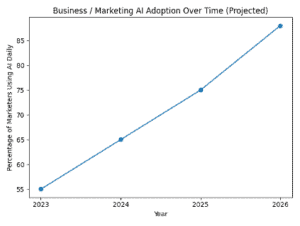
Generative AI is also reshaping how marketers interact with their tools. No longer confined to creative applications, gen AI is becoming embedded within every platform that marketers rely on like email automation systems, customer relationship management (CRM) platforms, design tools, analytics dashboards, and social media schedulers. By 2026, an estimated 80% of marketing analytics tools will be powered by AI, transforming predictive and prescriptive analytics into industry standards rather than innovative luxuries. The 88% of marketers already using AI daily will no longer be considered early adopters, they will represent the new norm.
A significant factor driving this shift is the rising use of AI among consumers. By 2025, approximately 58% of consumers are using generative AI to seek product and service recommendations, up from just 25% in 2023, according to Capgemini Research Institute. Additionally, over 70% of consumers report wanting AI integrated into their purchasing experience. As behaviors shift, so does the path to purchase: Pew Research Center found that users engage with fewer traditional search results when AI-generated overviews are presented. For marketers, particularly in sensitive fields such as healthcare, this signals the need to adapt strategies to accommodate AI-driven consumer journeys.
One often overlooked aspect of harnessing AI effectively is the quality of the prompts used to guide it. As AI becomes more capable, its output becomes increasingly dependent on the specificity, clarity, and detail of the instructions provided. A well-crafted prompt can dramatically improve accuracy, creativity, and relevance, enabling marketers to obtain exactly the type of content or analysis they need. Conversely, vague prompts can produce generic, misaligned, or incomplete results which wastes time and dilutes impact. Mastering prompt formulation is quickly becoming a critical skill for marketers, influencing everything from campaign development to data interpretation. AI is no longer a supplemental tool; it is steadily becoming the infrastructure that underpins marketing workflows. Campaigns are optimized, tested, and delivered in real time, driven by machine learning models and automated decision systems. Everyday tasks such as content optimization, audience targeting, and performance measurement are increasingly powered by AI engines operating behind the scenes.
In conclusion, the marketing environment of 2026 will be characterized by seamless AI integration across both consumer behavior and organizational operations. As AI matures from an optional enhancement to a structural necessity, marketers must embrace new technologies, refine their strategic approaches, and develop the skills needed to collaborate effectively with intelligent systems. Those who adapt early will be best positioned to leverage AI’s full potential by unlocking deeper insights, stronger customer relationships, and more impactful marketing outcomes in an increasingly automated world.